Australian Science Olympiad · JSO & Acceleration

Think Like a Scientist — Year 6 to the Olympiad.

Science competition preparation Australia

Olympiad-grade reasoning for Years 6–10 — subject-specific lessons across Biology, Chemistry, Physics and Earth Science, with deep reasoning and exam-style practice. First 3 lessons of every course free.

🔬 Biology · Chemistry
⚛️ Physics · Earth Science
🧠 Reasoning, not memorising
⚡ First 3 lessons free
Built on real JSO question typesModelled on real Junior Science Olympiad question types
Practise by subject & topicPhysics · Chemistry · Biology · Earth Science
Reasoning, not memorisationBuilt for how the Olympiad actually thinks
First 3 lessons freeTry any course risk-free

✓ Try before you buy

The first 3 lessons of every course are free to preview — no credit card needed. Unlock the full course whenever you're ready, and every remaining lesson opens instantly.

JSO or Chemistry Olympiad — where does your child start?

The two science pathways we prepare for. Tap each to see what it tests and where it leads.

Junior Science Olympiad (JSO)

Australian Science Innovations runs JSO exams for Australian students in Years 7–10, with Years 7–8 and Years 9–10 levels. The exam combines science knowledge with reasoning from unfamiliar information. Official entry and later invitations are separate from preparation courses.

  • Format Two-hour online exam across science strands
  • Strands Physics · Chemistry · Biology · Earth & Space · Skills
  • Who Official exam: Years 7–10. Year 6 students may explore preparation; this does not make them eligible to enter.
  • Our courses JSO Foundation, Advanced & the Bundle
See the science exam calendar → Read the full JSO exam guide →
Where it leads
1 JSO — Years 7–8 or Years 9–10 exam
2 ASO — senior Physics, Chemistry & Biology olympiads
3 Selection School — the Australian training squads
4 International — the world science olympiads

These are possible science opportunities, not an automatic progression. ASI determines invitations; taking our courses does not confer entry or selection. Official JSO entry information reviewed 3 October 2026.

Australian Science Olympiad — Chemistry

The senior chemistry olympiad pathway for Years 8–11. It tests applied problem-solving — reading data and reasoning through unfamiliar contexts — well beyond the school syllabus. Our Acceleration courses get younger students ahead first.

  • Format Written, olympiad-style problem solving
  • Level Years 8–11, beyond the school syllabus
  • Skills Applied reasoning over rote recall
  • Our courses Acceleration, Olympiad Foundation, Advanced & Mock
See the science exam calendar → Read the chemistry olympiad guide →
What it really tests
1 Applied reasoning — reading data & unfamiliar contexts, not memorising
2 Beyond school — content well past the Years 8–11 syllabus
3 One ladder — Acceleration → Foundation → Advanced → Mock
4 Selection — top scorers head toward the chemistry squad & IChO

The chemistry line runs from a Year 7–8 head-start all the way to olympiad selection — one coherent ladder.

From your child’s result to a practical next step

Find the difficulty that sounds familiar. Choose one action, try it, and use fresh work to check progress.

Which maths skills should a Year 9 student check before starting more demanding chemistry problems?

Check ratio, fractions, percentages, unit conversions, rearranging a simple equation and reading graphs before increasing chemistry difficulty. Fluent calculation helps only when the student understands what the quantities represent.

For a simple mass-concentration example, 6 g distributed through 3 L corresponds to 2 g/L; the units explain the division. Ask the student to predict what happens if the volume doubles while the mass stays fixed. Choose a year-appropriate foundation or acceleration outline before attempting specialist olympiad material.
How can a Year 8 student decide whether they are ready for physics acceleration rather than more school-level revision?

Readiness for acceleration is more than finishing school worksheets quickly. Check whether the student can interpret a graph, use units, rearrange a basic relationship and explain why an answer is physically reasonable.

Try an unfamiliar speed–distance–time example and ask for both a calculation and explanation. If essential arithmetic or graph reading blocks progress, repair that first; if the foundation is secure and curiosity remains, try a suitable acceleration sample. A Year 7–8 preparation course is distinct from entry to a senior Physics Olympiad.

How can an older student decide whether to move from broad junior science preparation towards chemistry olympiad study?

Move towards specialist chemistry when the student has the relevant foundations and wants deeper chemical reasoning, rather than simply because they have completed a junior course.

Review atomic ideas, reactions, quantities and supporting maths, then try a suitable worked problem independently. A student who needs broad science confidence may benefit from further junior preparation; an older student with secure foundations can inspect the Chemistry Olympiad Foundation outline. Confirm the organiser's entry and later selection rules separately from choosing a training course.

Which science extension course fits Year 7?

Choose a single-subject acceleration course when one interest or gap is clear, or inspect broad Junior Science Olympiad preparation when the student wants to connect several sciences. Our Year 7–8 chemistry, physics and biology outlines show the sequence and free starter lessons. Compare the actual tasks with your child’s current understanding before choosing a course.

What science extension options are available for Years 9–10?

The catalogue below includes Year 9–10 chemistry, physics and biology acceleration. These are subject-extension pathways; specialist Chemistry Olympiad preparation has a different depth and purpose. Start with the complete outline and a suitable sample, then choose one manageable next step. No private course automatically fulfils a school or university prerequisite.

Explore our Science Competition Courses →

Ace Achievers learning guidance · Updated 5 October 2026. Examples are illustrative, not student results or promises of an award. Course choice and official exam eligibility are separate.

Choose Your Course

From getting ahead of the school syllabus to Junior Science Olympiad mastery and senior chemistry olympiad prep — pick where you are. First 3 lessons of every course are free.

Acceleration · grade-specific
Accel
Found
Adv
Mock
Acceleration
Y7–8 Chemistry Acceleration
Lessons
20 lessons
Learning time
20–30 hrs
Difficulty
Year group
Y7–8
Best for
  • Curious students ready to master high-school chemistry early
By the end: Comfortable with high-school chemistry, well beyond the Y7–8 classroom.
A$369 one-time
Try 3 lessons free Full curriculum & details →
Accel
Found
Adv
Mock
Acceleration
Y9–10 Chemistry Acceleration
Lessons
30 lessons
Learning time
30–45 hrs
Difficulty
Year group
Y9–10
Best for
  • Students who want to stay ahead of the NSW syllabus and top their cohort
By the end: Ahead of the syllabus and set up for top school results in chemistry.
A$469 one-time
Try 3 lessons free Full curriculum & details →
Acceleration
Acceleration
Y7–8 Physics Acceleration
Lessons
30 lessons
Learning time
40–48 hrs
Difficulty
Year group
Y7–8
Best for
  • Y7–8 students ready to get ahead in high-school physics
By the end: Comfortable with NSW Stage 4 physics — forces, energy, machines and magnetism.
A$399 one-time
Try 3 lessons free Full curriculum & details →
Acceleration
Acceleration
Y9–10 Physics Acceleration
Lessons
45 lessons
Learning time
60–72 hrs
Difficulty
Year group
Y9–10
Best for
  • Y9–10 students who want to stay ahead of the NSW syllabus
By the end: Fluent in NSW Stage 5 physics — circuits, waves and motion (V=IR, λ=v/f, F=ma).
A$499 one-time
Try 3 lessons free Full curriculum & details →
Acceleration
Acceleration
Y7–8 Biology Acceleration
Lessons
30 lessons
Learning time
30–40 hrs
Difficulty
Year group
Y7–8
Best for
  • Y7–8 students ready to get ahead in high-school biology
By the end: Comfortable with NSW Stage 4 biology — cells, classification, body systems and ecosystems.
A$369 one-time
Try 3 lessons free Full curriculum & details →
Acceleration
Acceleration
Y9–10 Biology Acceleration
Lessons
30 lessons
Learning time
35–45 hrs
Difficulty
Year group
Y9–10
Best for
  • Y9–10 students who want to stay ahead of the NSW syllabus in biology
By the end: Comfortable with NSW Stage 5 biology — disease, DNA, genetics, inheritance and evolution.
A$469 one-time
Try 3 lessons free Full curriculum & details →
Chemistry
Physics
Biology
Bundle · Best value
Y7–8 Science Acceleration Bundle
Courses
3 courses in one
Lessons
80 lessons
Learning time
90–118 hrs
Year group
Y7–8
Best for
  • Want all three Y7–8 sciences — Chemistry, Physics and Biology — accelerated in one purchase
  • Ready to get ahead across the whole science syllabus, not just one subject
By the end: Ahead of the syllabus in all three sciences — chemistry, physics and biology — one complete package, one dashboard.
A$1137A$999 one-time
📚 Course details — see the full 20-lesson syllabus, no sign-up needed →Get the bundle — save A$138 See the courses →
Chemistry
Physics
Biology
Bundle · Best value
Y9–10 Science Acceleration Bundle
Courses
3 courses in one
Lessons
105 lessons
Learning time
125–162 hrs
Year group
Y9–10
Best for
  • Want all three Y9–10 sciences — Chemistry, Physics and Biology — accelerated in one purchase
  • Ready to stay ahead of the NSW syllabus across every science subject
By the end: Ahead of the syllabus in all three sciences — chemistry, physics and biology — one complete package, one dashboard.
A$1437A$999 one-time
📚 Course details — see the full 30-lesson syllabus, no sign-up needed →Get the bundle — save A$438 See the courses →
Junior Science Olympiad · Years 7–10
Foundation
Advanced
Foundation
JSO Foundation
Lessons
29 lessons + reference sheet
Learning time
30–40 hrs
Difficulty
Year group
Y7–8
Best for
  • Concept mastery across all five strands — Science Skills, Physics, Chemistry, Biology & Earth Science
  • New to the Junior Science Olympiad and want every concept taught from zero
By the end: A solid grasp of every core JSO topic, built from the ground up.
A$399 one-time
Try 3 lessons free Full curriculum & details →
Foundation
Advanced
Advanced
JSO Advanced
Lessons
29 lessons + reference sheet
Learning time
35–45 hrs
Difficulty
Year group
Y7–8
Best for
  • Have the concepts and want to push from ~60% to 95%+
  • Want every recent exam fully worked, plus timed mocks
By the end: Fluent on the full set of recent JSO exams, with the thinking shown.
A$399 one-time
Try 3 lessons free Full curriculum & details →
Foundation
Advanced
Bundle · Best value
JSO Foundation + Advanced
Lessons
58 lessons + 2 reference sheets
Learning time
65–85 hrs
Difficulty
Year group
Y7–8
Best for
  • Want the complete JSO pathway — concepts → exams → mocks — at the best value
By the end: Concept mastery plus every recent exam — the full preparation in one.
A$798A$599 one-time
📚 Course details — see the full 29-lesson syllabus, no sign-up needed →Get the bundle See both courses →
Chemistry Olympiad · Years 8–11
Accel
Found
Adv
Mock
Foundation
Chemistry Olympiad Foundation
Lessons
40 lessons
Learning time
40–60 hrs
Difficulty
Year group
Y8–11
Best for
  • Building the core toolkit for the Australian Science Olympiad chemistry exam
By the end: A complete foundation for the ASO chemistry exam.
A$569 one-time
Try 3 lessons free Full curriculum & details →
Accel
Found
Adv
Mock
Advanced
Chemistry Olympiad Advanced
Lessons
48 lessons
Learning time
48–72 hrs
Difficulty
Year group
Y8–11
Best for
  • Students chasing High Distinction and squad selection
By the end: Exam-level problem solving across the full ASO chemistry syllabus.
A$569 one-time
Try 3 lessons free Full curriculum & details →
Accel
Found
Adv
Mock
Mock
Chemistry Olympiad Mock Exam
Lessons
28 mock papers
Learning time
28–42 hrs
Difficulty
Year group
Y8–11
Best for
  • Final timed practice before the real olympiad exam
By the end: Tested under real exam conditions, with full solutions to learn from.
A$369 one-time
Try the first mock free Full curriculum & details →
Why Ace for Science Olympiad

Every JSO topic, cracked by reasoning — understanding over memorisation.

We break every Junior Science Olympiad paper down by subject and concept, then drill the reasoning each one needs — targeted practice on exactly what the Olympiad tests.

Real question bank

Every JSO question type across all five subjects — worked step by step, not just listed.

By subject & topic

Physics, Chemistry, Biology, Earth Science — mastered concept by concept.

Reasoning first

Built for how the Olympiad thinks — explaining why, not memorising what.

Targeted practice

Diagnose the weak topics first, then practise exactly those with 3-layer hints.

School Acceleration → Junior Science Olympiad → Australian Science Olympiad
Learning Method

Concept First. Then Experiments. Then Mastery.

Every week: understand the principle, see it in a real experiment, predict outcomes, verify with data. The cycle that turns memorisation into reasoning.

  • Principle → Experiment → Predict → Verify → Apply
  • Hands-on virtual labs + real exam-style problems
  • Quantitative + qualitative reasoning equally strong
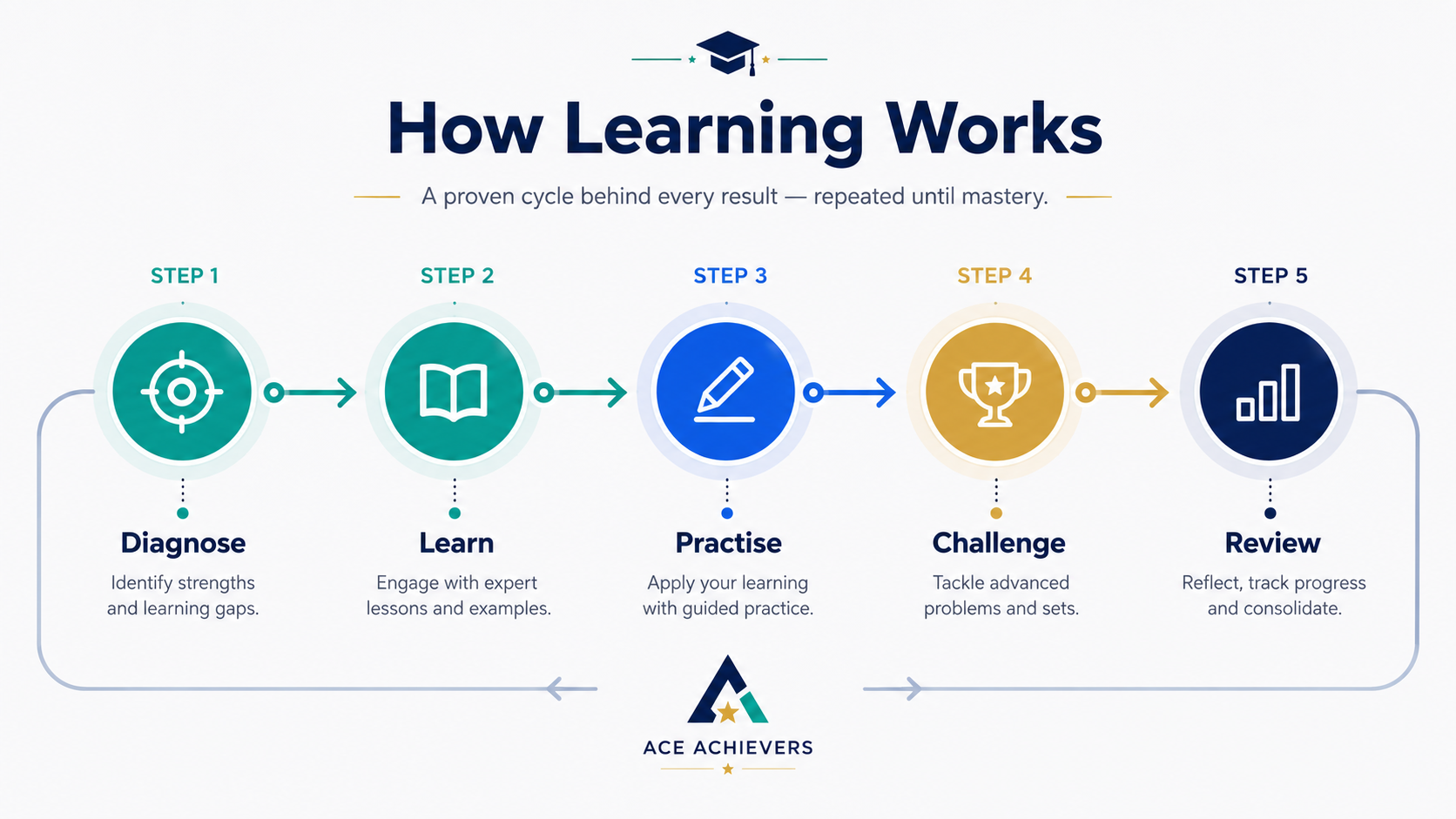
How learning works - a proven 5-step cycle: Diagnose, Learn, Practise, Challenge, Review
Help When Needed

3-Layer Reasoning Hints

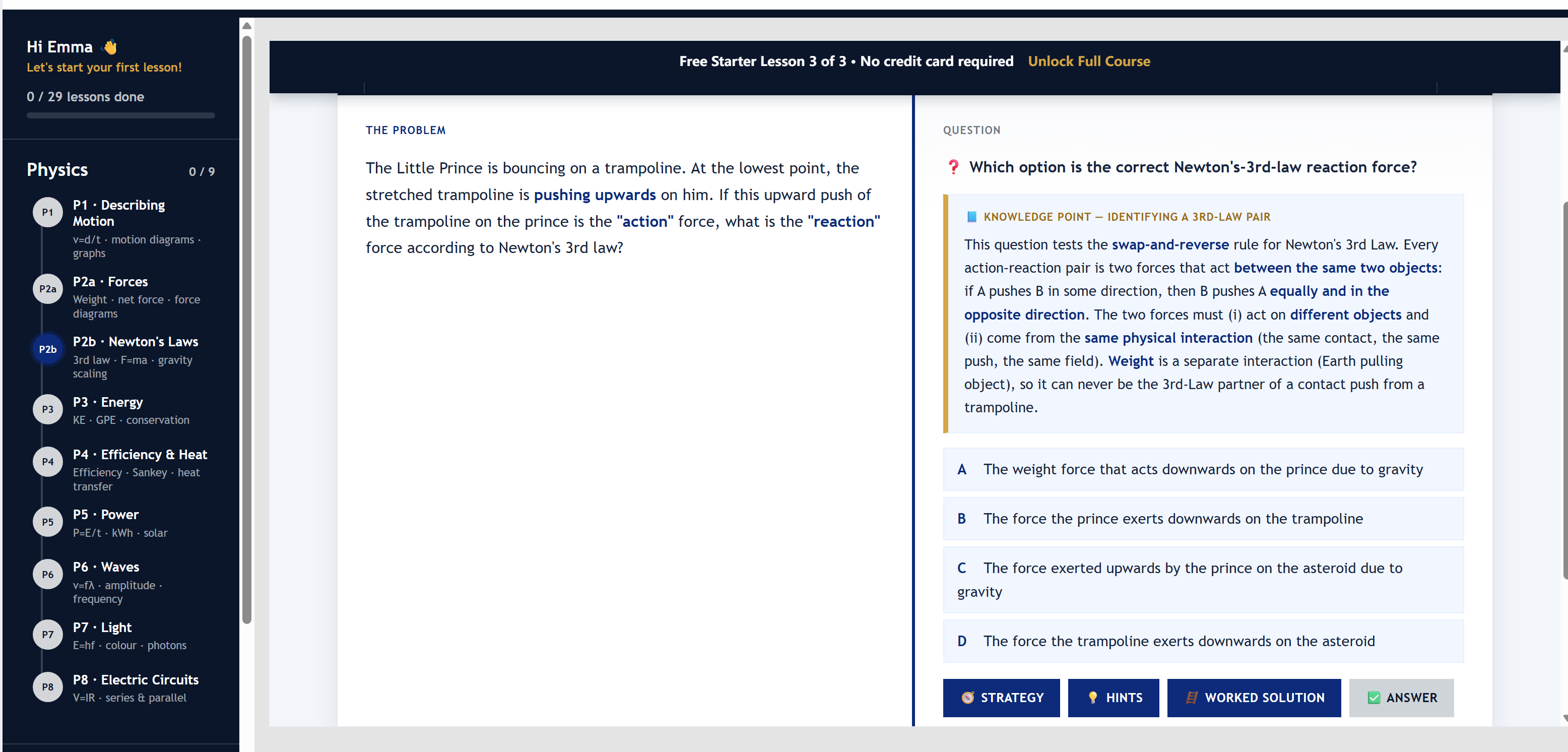
Stuck on a tricky experiment question? Get the right level of help — from a gentle nudge to the full reasoning chain.

  • Nudge — Which principle applies here?
  • Guided Hint — What variables and relationships matter?
  • Full Reasoning — Complete walkthrough with diagram
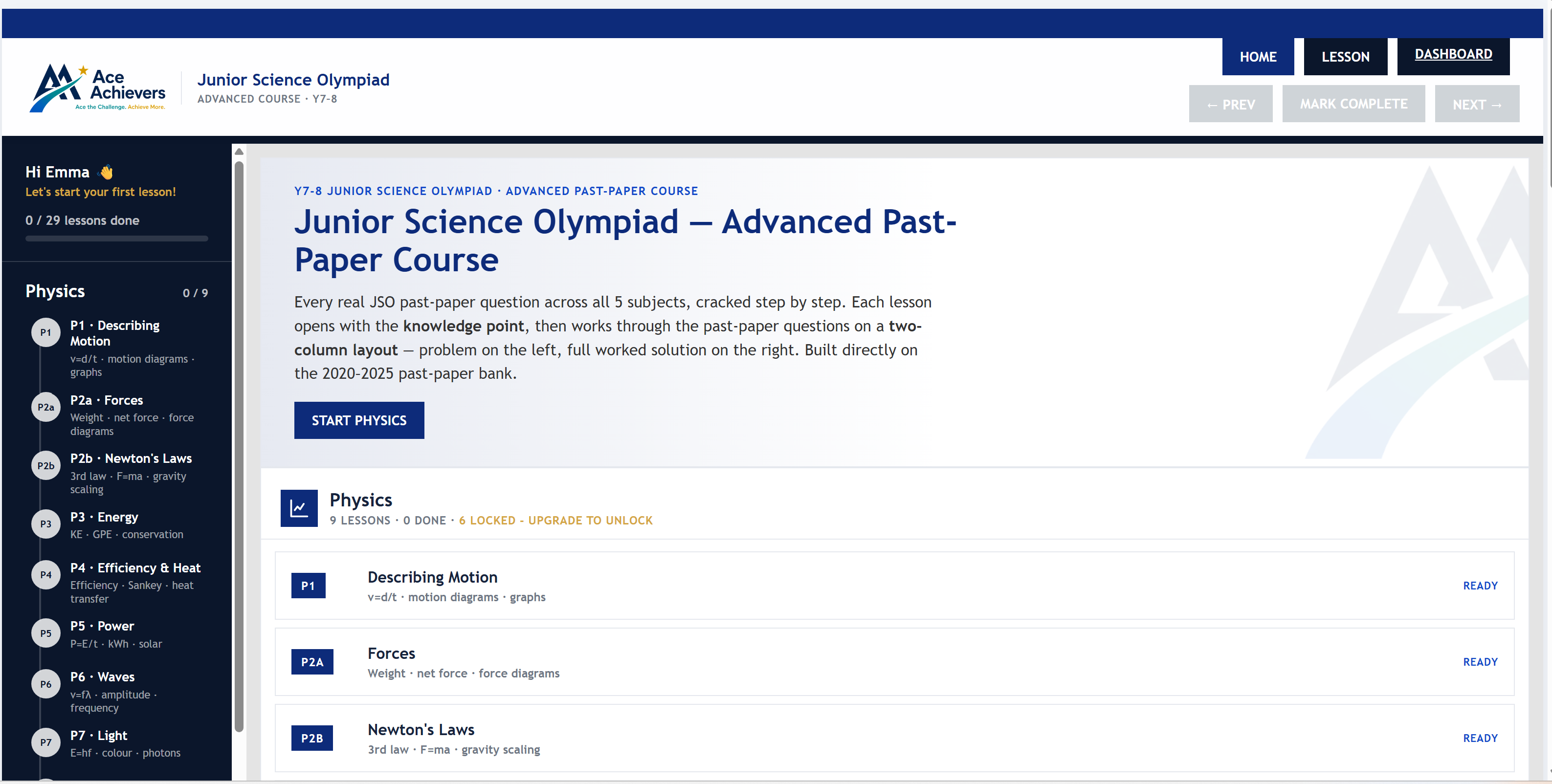
A science lesson with the knowledge point and a full step-by-step worked solution
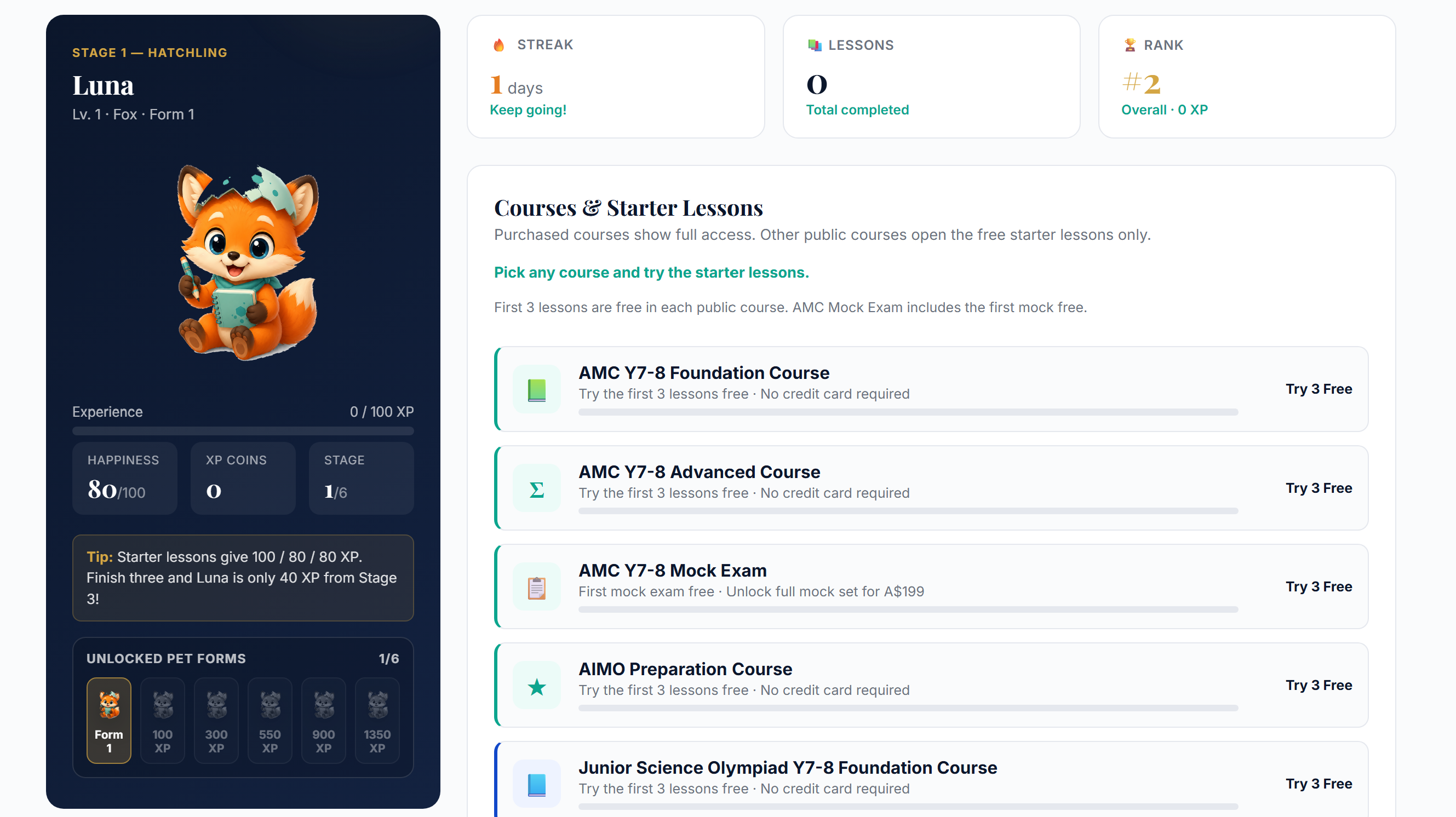
Student dashboard - courses, streak, XP and today's challenge
Student View

Curiosity Becomes Routine

Current strand, streak, upcoming challenges, badges earned — everything that turns interest into habit.

  • Active strands with progress bars
  • Daily streak counter — builds habit
  • Upcoming challenges + badges earned
Parent View

See Progress by Strand

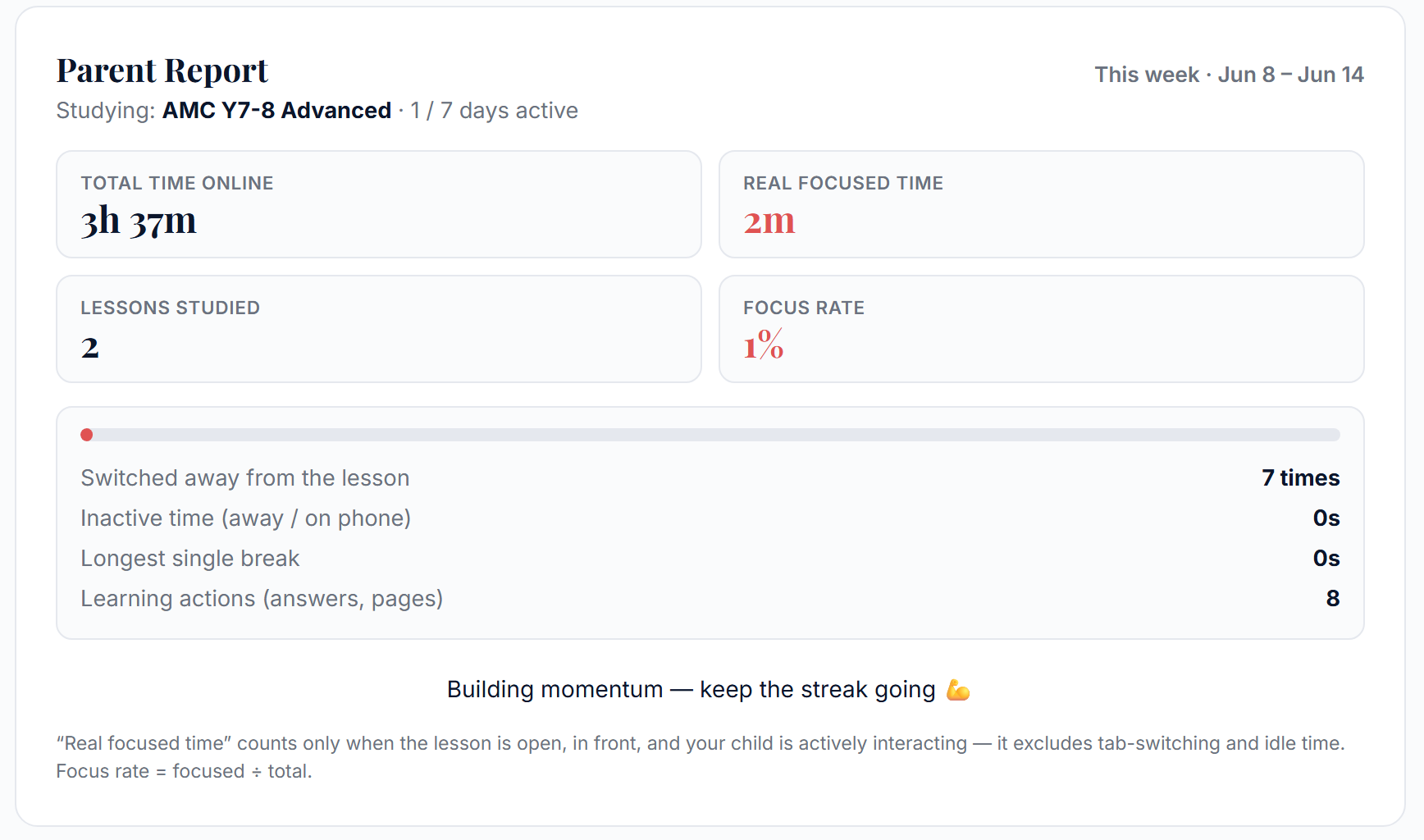
Weekly email: which strands they mastered, where they got stuck, and what's next.

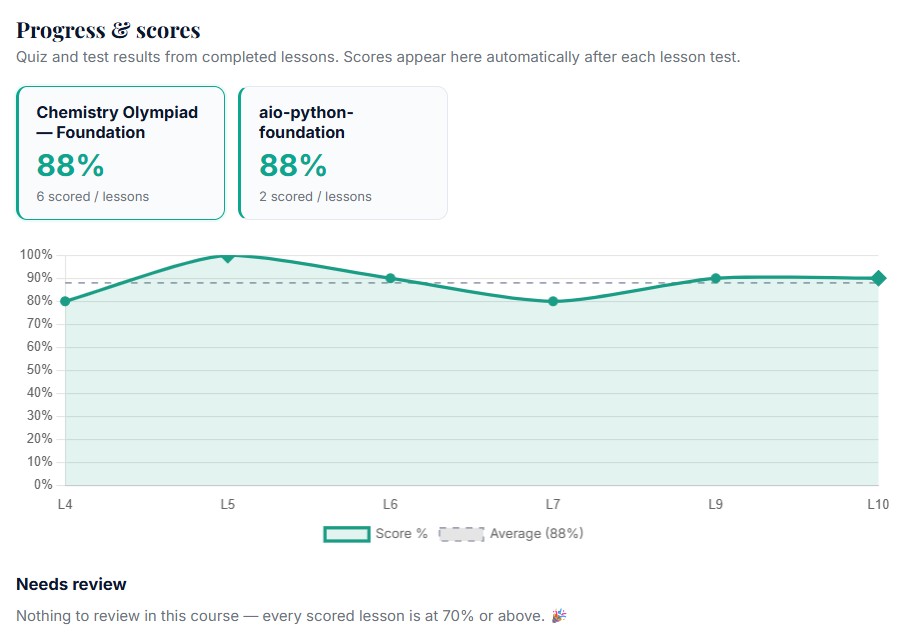
  • Strand-by-strand mastery (Physics/Chem/Bio/Earth)
  • Reasoning score trend
  • Weakest concepts highlighted with revision links
Weekly parent report - total time, real focused time and progress

Free Science Learning Resources

Hand-picked free videos, games, simulations and interactive periodic tables — for curious students aged 10–18.

Winter sprint · 6–19 July

Two weeks off. One big head start.

While the holidays slip by for everyone else, your child could finish them a full term ahead in science — atom-first, self-paced, no classroom needed.

Get ahead this winter
AMC · sat in July

The five questions that separate the medallists.

Q26-30 stump 95% of students — even the bright ones. Make them second nature now, and your child walks into the paper ready.

Master Q26-30
AMC · Years 5-6

Confidence is built earlier than you think.

Give your Year 5-6 child the head start that makes maths feel winnable — long before the competition pressure ever begins.

Start them ahead
Australian Informatics Olympiad

Coding is your child's unfair advantage.

From zero Python to real competition algorithms, right in the browser — the one skill that keeps paying off for the next decade.

Open the AIO pathway
Science Olympiad · Years 7-10

For the child who never stops asking 'why?'

Turn that curiosity into real results — Physics, Chemistry, Biology and Earth Science, taught concept-first, never crammed.

Explore the olympiad
Refer a friend

The best things get passed parent to parent.

Know another family chasing the same goals? They save 20%, you earn credit toward your next course. Everyone's child wins.

Share & save 20%
Start free today

You'll see the difference in 3 lessons.

No credit card, no risk. Open any course and watch it click for your child — the first 3 lessons are on us.

Start free

Choosing a first science competition?

Use our Big Science preparation guide to practise interpreting evidence and find gaps in science understanding. Then compare the relevant year-level course curriculum; a competition result alone does not determine placement.

Preparing for high school and choosing what comes next

Start with your child’s school-learning needs. Explore competition or acceleration courses when the curriculum fits their interests and readiness.